Who owns the company, and who controls the vote.
Ask about a company and its shareholders arrive as a cap table read from the securities register. Who can pass or block each kind of resolution is then counted from those holdings and each class's votes per share; each conclusion cites the Act, and the answer reads “Needs lawyer confirmation”.
In pilot. Running at a pilot firm. Voting control is worked out for companies under the OBCA and the CBCA.
How it works. From the register to a lawyer's review.
Ask about a company
Name it, or ask from one of its matters. Its holders are read from the securities register and each class's votes per share from its share-class record, and the answer sets them out as a cap table.
The votes are counted
Shares times votes per share, for each holder, in exact fractions. The answer says who can pass or block each kind of resolution, cites the provision, and reads “Needs lawyer confirmation”.
A change waits for approval
Record a transfer or an allotment from the card. It waits as a proposal until another administrator at the firm approves it (in a firm with one administrator, that administrator, with a recorded reason), and the register is then added to, never edited.
The cap table, from the register. Never typed in again.
The card sets a company out the way a lawyer would: a row per holder, a column per share class, total shares, the percentage of equity and, once every class's votes per share are confirmed, the percentage of votes. A label says where the figures come from and as of when.
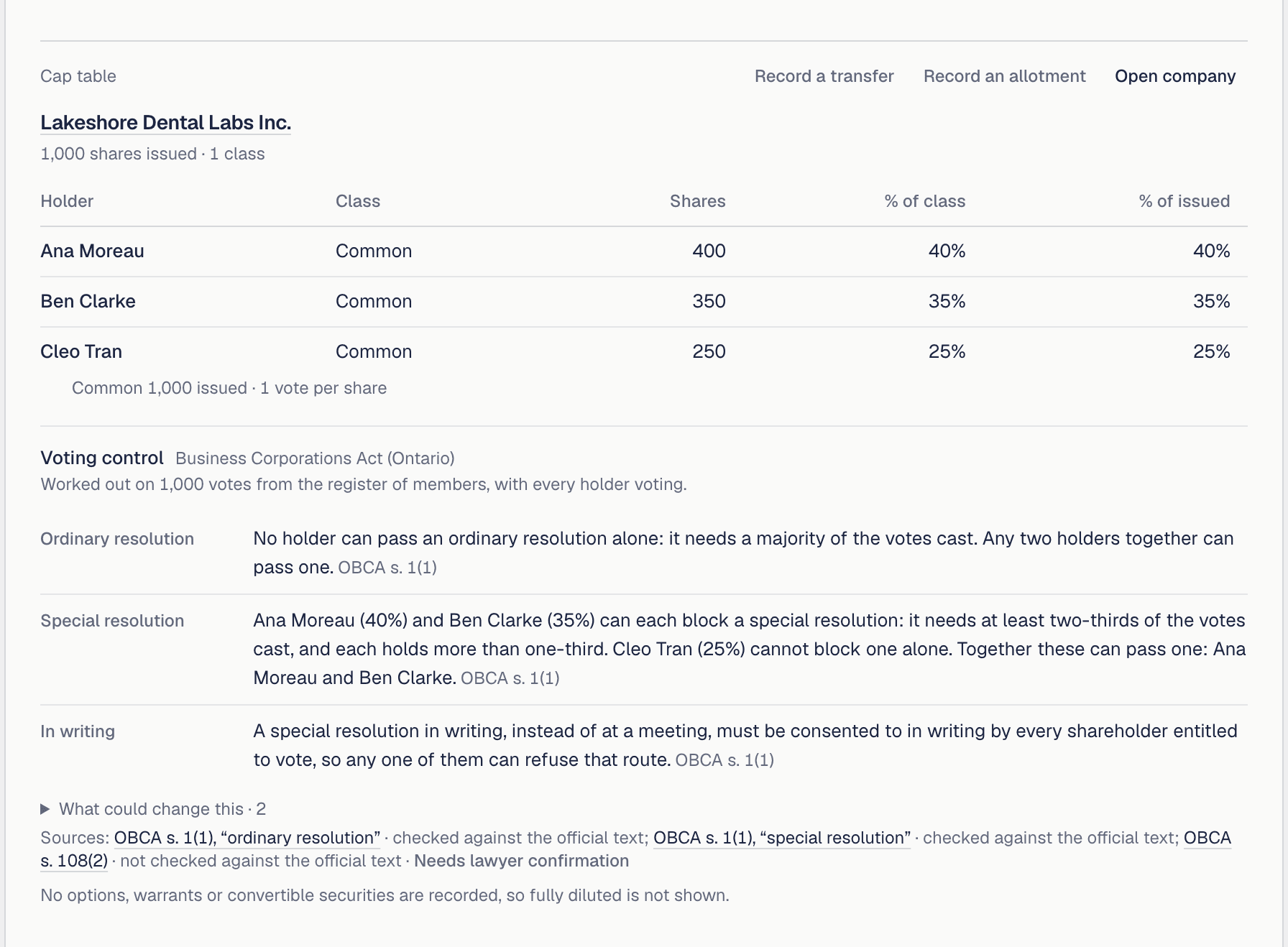
Holders at or over the significant-control threshold for the company's jurisdiction are marked by their share of equity or of votes, with the rule named. Where no rule for that jurisdiction is held, nobody is marked. Fair market value, joint holdings, control in fact and the individuals behind a corporate holder are left to the lawyer.
Where the company has adopted an option plan, switch between issued and fully diluted: issued shares, outstanding options and the unallocated pool. A plan not yet adopted is listed, not counted.
Copy pastes into Word or a spreadsheet as a table; Download saves it as a CSV file.
When the register is empty and the company has a matter, the card shows the matter's working figures, labelled “Pro forma — from the matter, not the register”, and never works out voting control from them.
An exported answer prints the cap table as a real table. The company's record exports to Word or PDF with its share structure and an ownership diagram drawn from the registers.
Control is counted, never guessed.
Who can carry or stop a resolution is arithmetic on the votes, and the card does it exactly: each holder, and the smallest groups of holders that can carry or block it, measured against the lines the Act sets. Nothing is rounded, so a holder of exactly one-third is never counted as able to block.
Ordinary resolution
Passes with a majority of the votes cast. No one here holds more than half, so no one can pass one alone; any two holders together can.
OBCA s. 1(1) · CBCA s. 2(1)
Special resolution
Passes with at least two-thirds of the votes cast, so more than one-third can block one. Ana Moreau and Ben Clarke can each block one; together they can pass one.
OBCA s. 1(1) · CBCA s. 2(1)
In writing
A special resolution in writing, instead of at a meeting, needs every shareholder entitled to vote, so any one of them can refuse that route.
OBCA s. 1(1) · CBCA s. 2(1)
What it will not assume. And what it leaves to the lawyer.
Voting control rests on facts the register doesn't always hold. Where one is missing, the card says what it assumed, or works nothing out and says why. The questions it does not work out at all are named here too.
The thresholds count the votes cast, not the votes outstanding. The card assumes every holder votes and says so; if one stays away, the others' share rises. Staying away can also leave a meeting without a quorum, which the card does not work out.
A class whose votes per share aren't confirmed is counted at one vote a share, the default unless the articles provide otherwise, and the card names the class.
A class with no votes is left out of the count, with a note that it may still vote separately as a class on some changes to the articles. The count is for ordinary business: on an amalgamation, a continuance or a sale of substantially all the property, non-voting shares can vote too.
The card says a special resolution in writing needs every voting shareholder. An Ontario company that is not an offering corporation can also pass an ordinary resolution in writing with a majority's signatures; the card does not yet work that route out.
Every result notes that a unanimous shareholder agreement can change who decides what, and that the articles set each class's rights.
If the card doesn't hold the whole register, or more than one holding has no holder's name, it works nothing out and says why.
For a company outside the OBCA and the CBCA, or one whose governing Act isn't on record, voting control is not worked out.
What's in place. And what's in pilot.
Voting control, countedIn place
Who can pass or block an ordinary or a special resolution is calculated from the votes, in exact fractions, for companies under the OBCA and the CBCA, along with the smallest groups that can do it together (named where there are ten voting holders or fewer). The answer is handed the result to report.
Cited, and compared with the Act's textIn place
Each conclusion cites the provision it rests on, and the provision's text on e-Laws or Justice Laws is searched for the words the conclusion relies on. A citation that could not be compared is still shown, and says so. Every result reads “Needs lawyer confirmation”.
What could change the answerIn place
Each result carries its caveats: votes cast, unconfirmed votes per share, non-voting classes, separate class votes and shareholder agreements. A register the card cannot read whole gets no conclusion.
A register that is only added toIn place
Entries on the securities register, and on the other statutory registers, are never edited or deleted. A correction is a new entry that points to the one it replaces.
Register changes wait for approvalIn place
A register change the advisor or an agent prepares is a proposal until another administrator at the firm approves it (in a firm with one administrator, that administrator, with a recorded reason). For a transfer or an allotment, a resolution on the company's matters or its client's file marked signed, filed, approved or uploaded, the share class and, for a transfer, the transferor's holding are checked when it is proposed and again when it is approved. The resolution's terms are not read.
The cap table cardIn pilot
In the advisor, a company's cap table arrives as a card, with an ownership bar, significant-control marks and, where an option plan is adopted, fully diluted figures. Copy it as a table or download it as CSV. A voting line on the card that doesn't follow from the card's own figures is replaced by the calculated one.
Ownership chartIn pilot
Each holder's direct and attributed interest, with the holders of a holding company set beneath it, marked against the significant-control rule the card names. Where the record cannot decide, it says “Cannot tell from the record”.
Record a transfer or an allotmentIn pilot
From a register card, a short form drafts the change for approval, naming a resolution from the company's matters or its client's file to authorise it. Without one marked signed, filed, approved or uploaded, the change cannot be proposed.
The company record in one fileIn pilot
A company's record downloads as one Word or PDF file with the firm's branding: particulars, directors and officers, the share structure, an ownership diagram drawn from the registers, the register of individuals with significant control and the minute book's contents.
Share structures on a matterIn pilot
On a formation or share-purchase matter, try a share structure as a named pro forma table and compare scenarios side by side. A scenario never changes the register; using one drafts a single proposal for approval.
The rules a change follows.
Who approves a proposed change
A change the advisor, an agent or a card prepares is approved by an administrator at the firm other than the person who proposed it. In a firm with one administrator, that administrator can approve their own proposal with a written reason, and the record keeps the reason.
An entry recorded by hand
A person at the firm can also record an entry directly on the company's Registers tab. It is written at once, without a proposal, and the entry keeps who recorded it.
What authorises a share change
A transfer or allotment proposed from the card or the advisor needs a resolution on the company's matters or its client's file, marked signed, filed, approved or uploaded. A draft the firm is still writing, or a copy still out for signature, never authorises one. The resolution's terms are not read; that is for the lawyer. Applying a share structure from a matter is the exception: with no resolution linked, each allotment is recorded as “resolution pending”.
Votes per share
Recorded with each share class. Where a class has none recorded, the card counts one vote a share and says the votes are not confirmed.
Questions
- Which companies does voting control cover?
- Companies under the Business Corporations Act (Ontario) and the Canada Business Corporations Act. For a company under another Act, or one whose governing Act isn't on record, the card says voting control was not worked out, and why.
- Can a 40% shareholder block a special resolution?
- Under both Acts a special resolution needs at least two-thirds of the votes cast, so a holder of more than one-third of the votes cast can stop one when everyone votes. A holder of exactly one-third cannot: the others hold exactly two-thirds, and it passes. The card works this out from the register and says it needs lawyer confirmation.
- What if a shareholder doesn't vote?
- The thresholds count votes cast, not votes outstanding. The card assumes every holder votes and says so. If someone abstains or stays away, the others' share of the votes cast rises, and so can what they can do. Staying away can also leave a meeting without a quorum (by default, the holders of a majority of the voting shares: CBCA s. 139(1), OBCA s. 101(1)); the card does not work quorum out.
- What about a resolution in writing?
- Under both Acts a special resolution in writing, instead of at a meeting, has to be signed by every shareholder entitled to vote on it (CBCA ss. 2(1), 142(1); OBCA ss. 1(1), 104(1)), so any one of them can refuse that route. An Ontario company that is not an offering corporation can also pass an ordinary resolution in writing signed by the holders of a majority of the voting shares, with notice to the others within 10 business days (OBCA s. 104(1)(c), (3)). The card does not yet work that route out. Neither route is open where a director or auditor has given a written statement under the Act.
- Does recording a transfer from the card change the register straight away?
- No. From the card or the advisor it becomes a proposal. It needs a resolution on file, marked signed, filed, approved or uploaded, and another administrator at the firm approves it before anything is written (in a firm with one administrator, that administrator, with a recorded reason). The register is then added to; nothing earlier is edited. A person can also record an entry directly on the company's Registers tab; it is written at once, with who recorded it.
Cap tables, ownership charts and voting control are prepared for a lawyer’s review. Nothing on this page or in the product is legal advice; a lawyer confirms before anyone relies on it. Examples use synthetic people and companies.
Join the firms building on Misolla.See it on a matter like yours.
Private beta. Concierge onboarding. Migration from your existing tools. Co-designed workflows for your practice.
Book a callConcierge onboarding · limited seats