Research paper · August 24, 2026
The Canadian Legal Productivity Gap
Market, productivity, talent, and what hyper-specialized legal AI can return to Canada’s economy — the research behind Misolla AI’s Canada-only pivot
Abstract
Canada has a productivity problem its own central bank calls an emergency, an economy built on very small firms that spend more on regulation per employee than almost anyone, and a persistent leak of its most capable people to the United States. It also has a legal-services industry that is 74% micro-businesses, that leaves four in five people with a serious legal problem without legal advice, and whose real output has been flat since 2021. This paper assembles the primary evidence on each of those facts, examines the measured effect of AI on legal work, and models what fully automated, Canada-specific legal workflows could return in professional hours and dollars. Under conservative assumptions the gain is about 10 million lawyer-hours a year; under a base case it is roughly 21 million hours, equivalent to 11,000 full-time lawyers, and consistent with what Canadian lawyers themselves expect from AI. Every figure cited was fetched from its source and independently re-fetched; the method is described at the end.
1. Summary of findings
Canada does not have a shortage of good law or of capable lawyers. It has a deployment problem: the work is done by hand, in very small firms, under regulation that costs the smallest businesses seven times more per employee than the largest, while the country’s output per hour drifts further from the United States each decade.
-
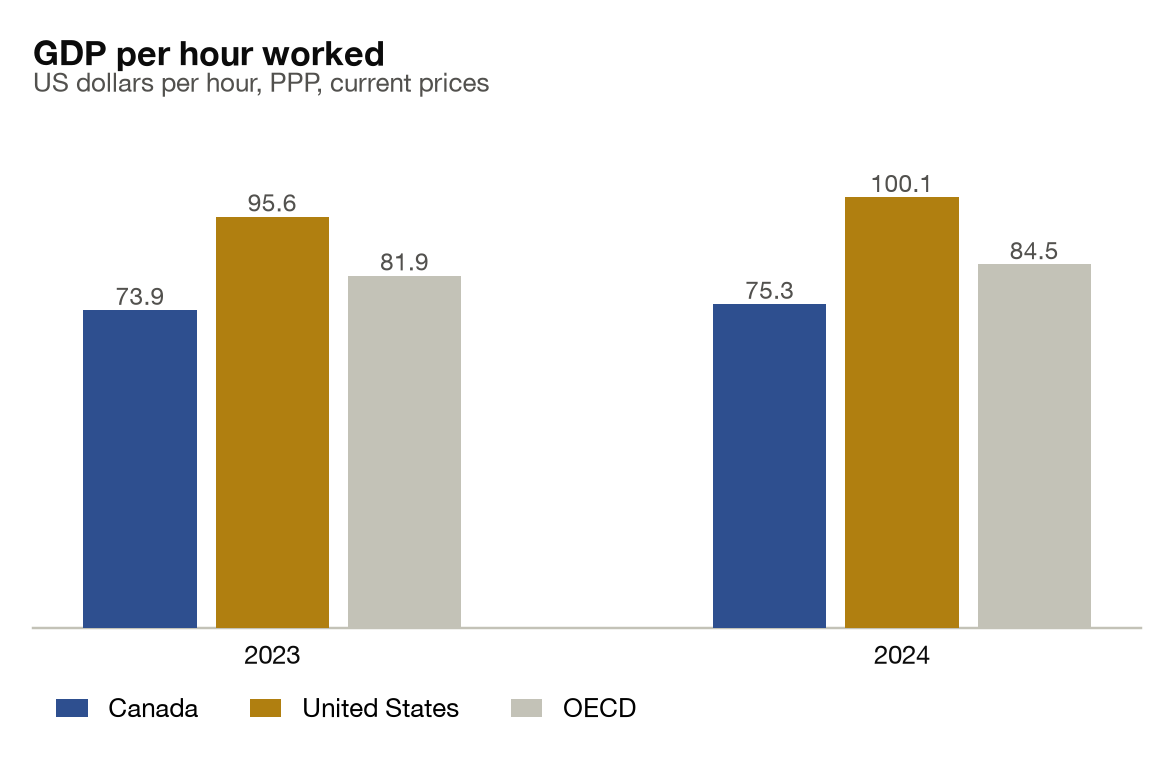
Productivity. Canada produced US$75.3 of GDP per hour worked in 2024, 75% of the US level and below the OECD aggregate1. Relative to the United States, Canadian labour productivity has fallen 26% since 19972. The Bank of Canada’s Senior Deputy Governor called it an emergency: “it’s time to break the glass”3.
-
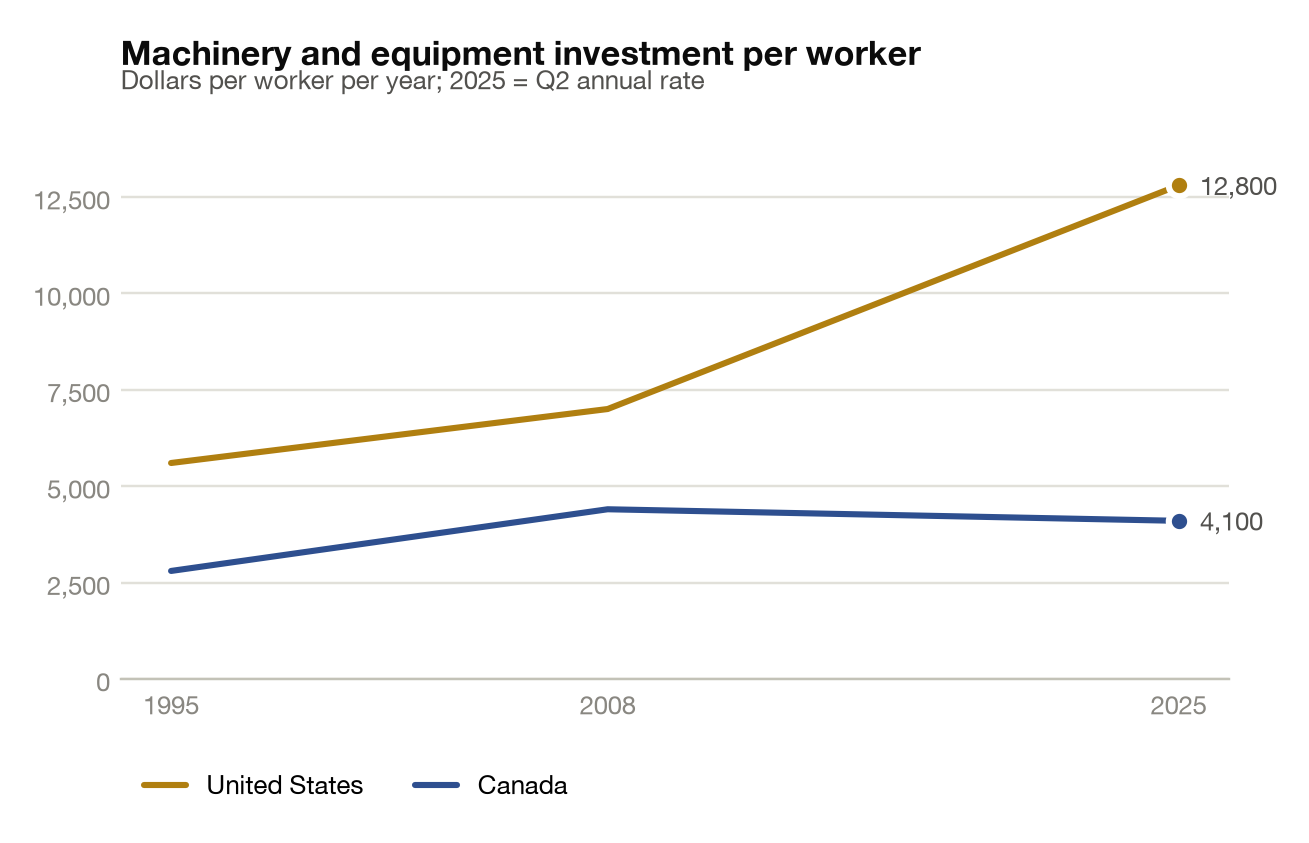
Investment. Canadian workers will receive about 55 cents of new business capital in 2025 for every dollar received by US workers; machinery-and-equipment investment per worker is 32 cents on the US dollar, down from 63 cents in 20084,5.
-
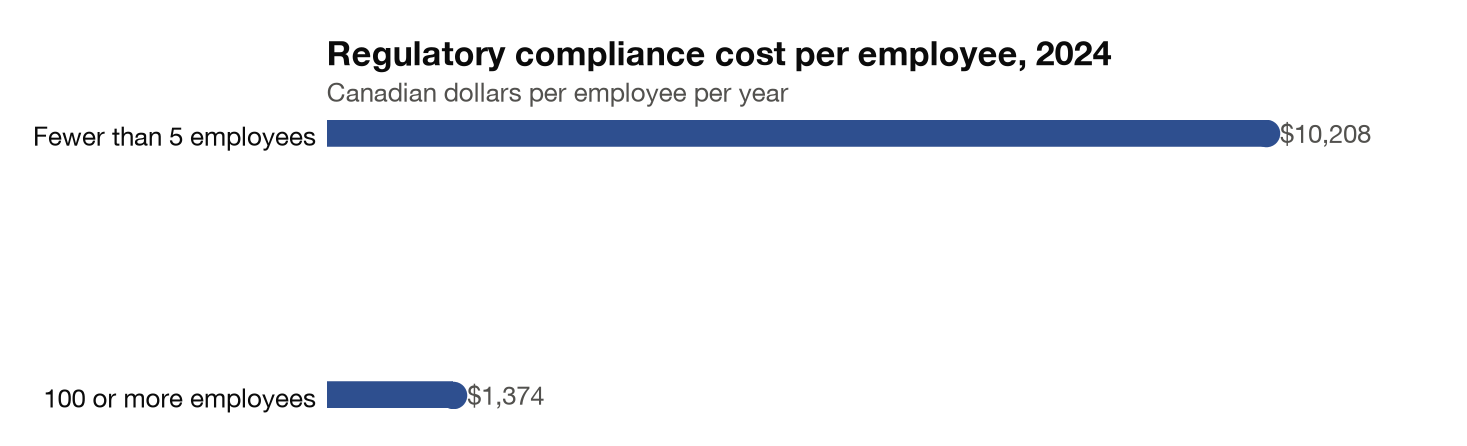
Small firms and red tape. 98.2% of Canada’s 1.10 million employer businesses are small6. Regulation cost them $51.5 billion in 2024 and 768 million hours7; a firm with fewer than five employees pays $10,208 per employee to comply, versus $1,374 for a firm with 100 or more8.
-
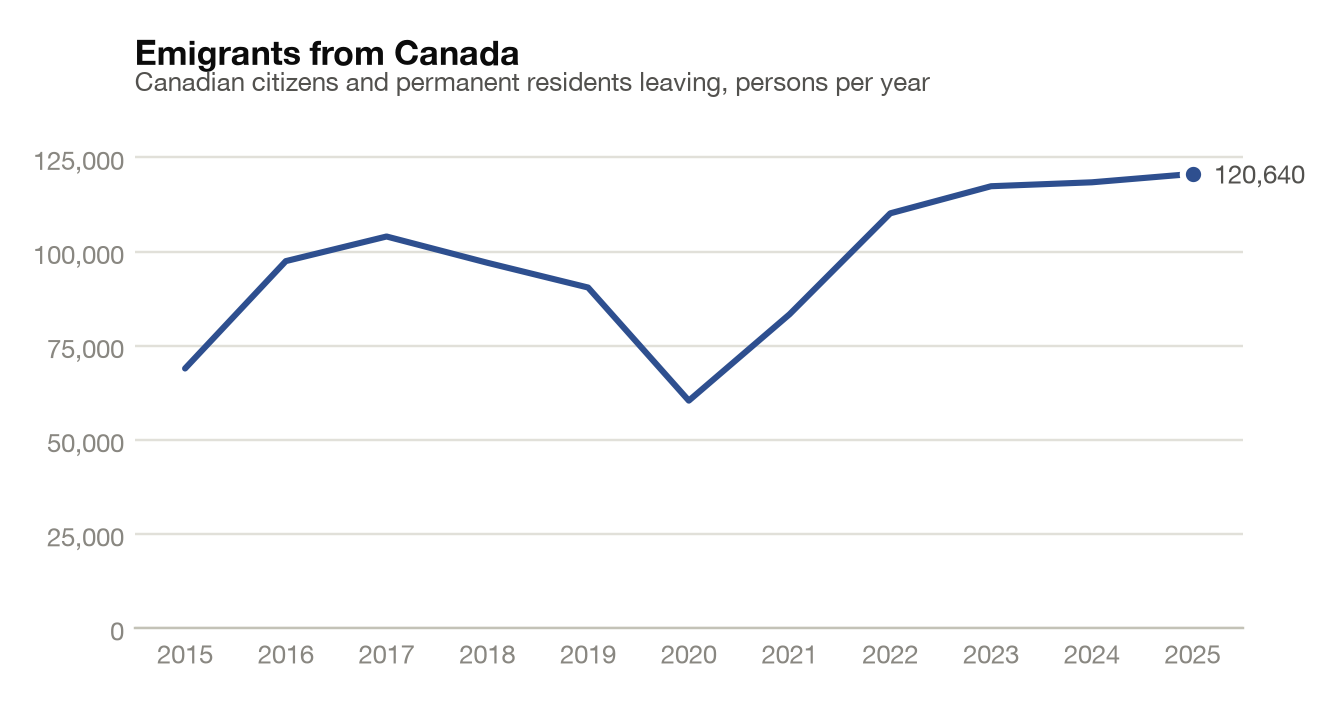
Talent. A record 120,640 citizens and permanent residents emigrated in 20259; close to 70% of emigrants hold a university degree and 61% of Canadian-born people living abroad are in the United States10. Bank of Canada researchers estimate at least 40% of Canadians with top-1% earning ability live outside Canada11.
-
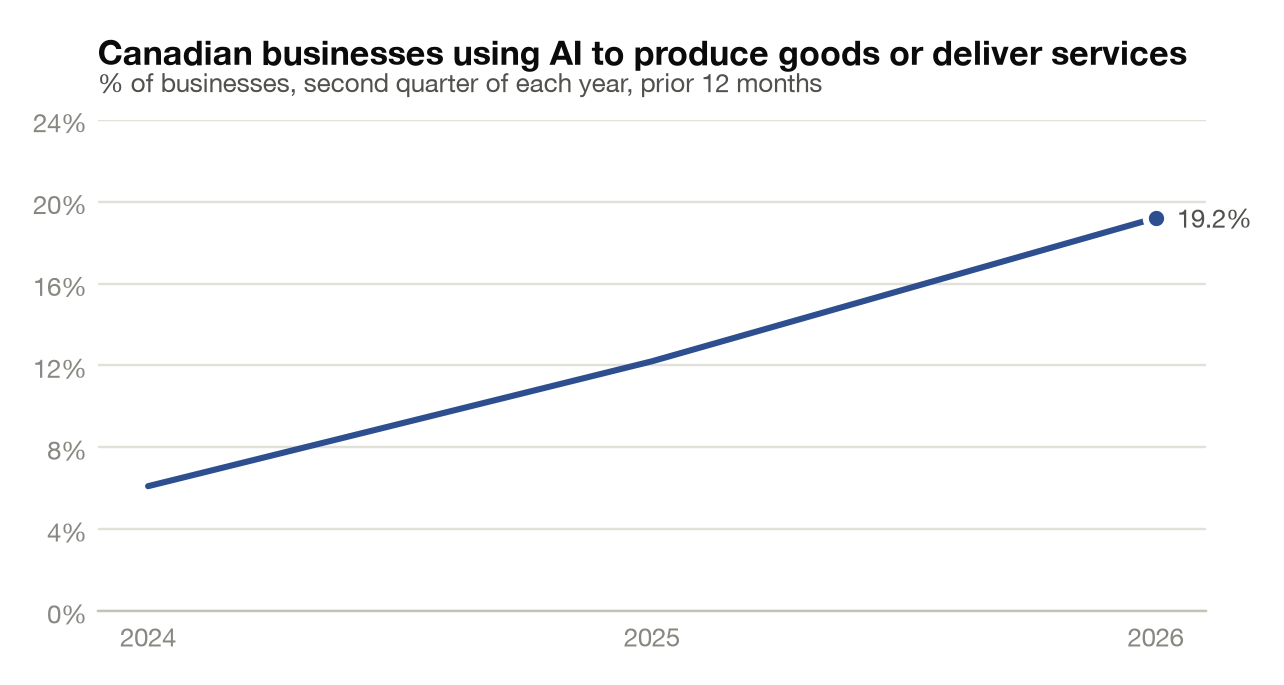
AI. Canada ranks second in the world in AI research papers per capita12, yet only 19.2% of its businesses use AI to produce goods or deliver services13, only 8% report significant operational use14, and only 7% of Canadian law firms have fully implemented AI across practice areas15.
-
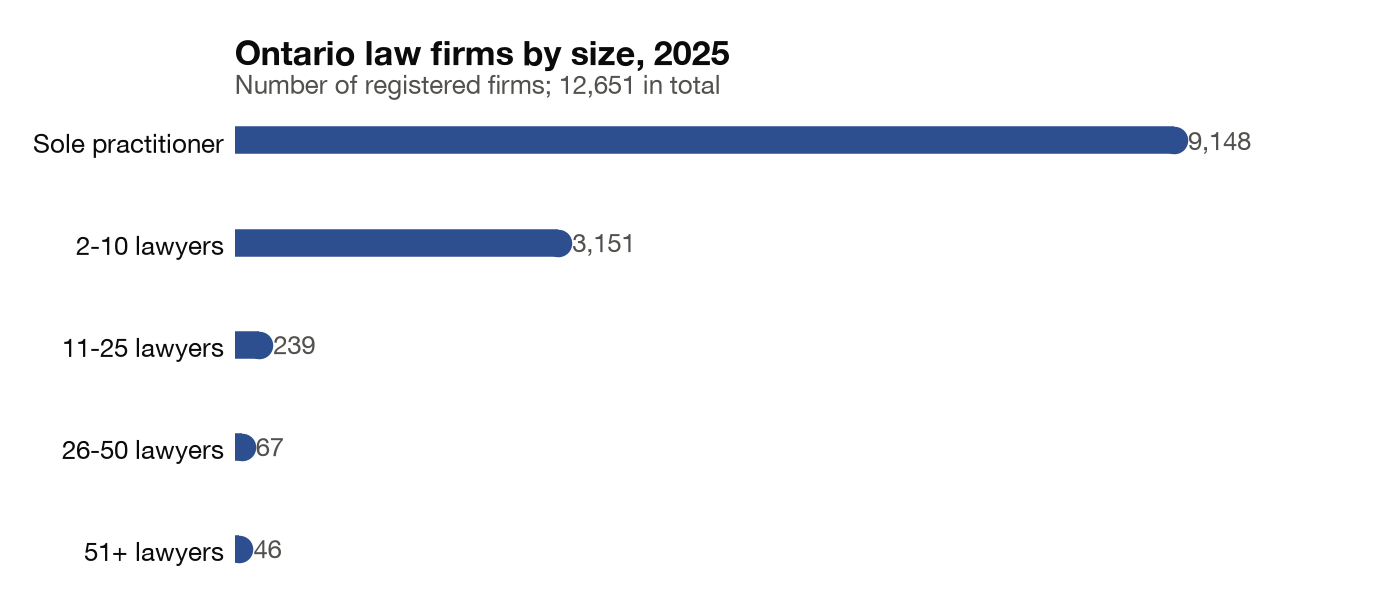
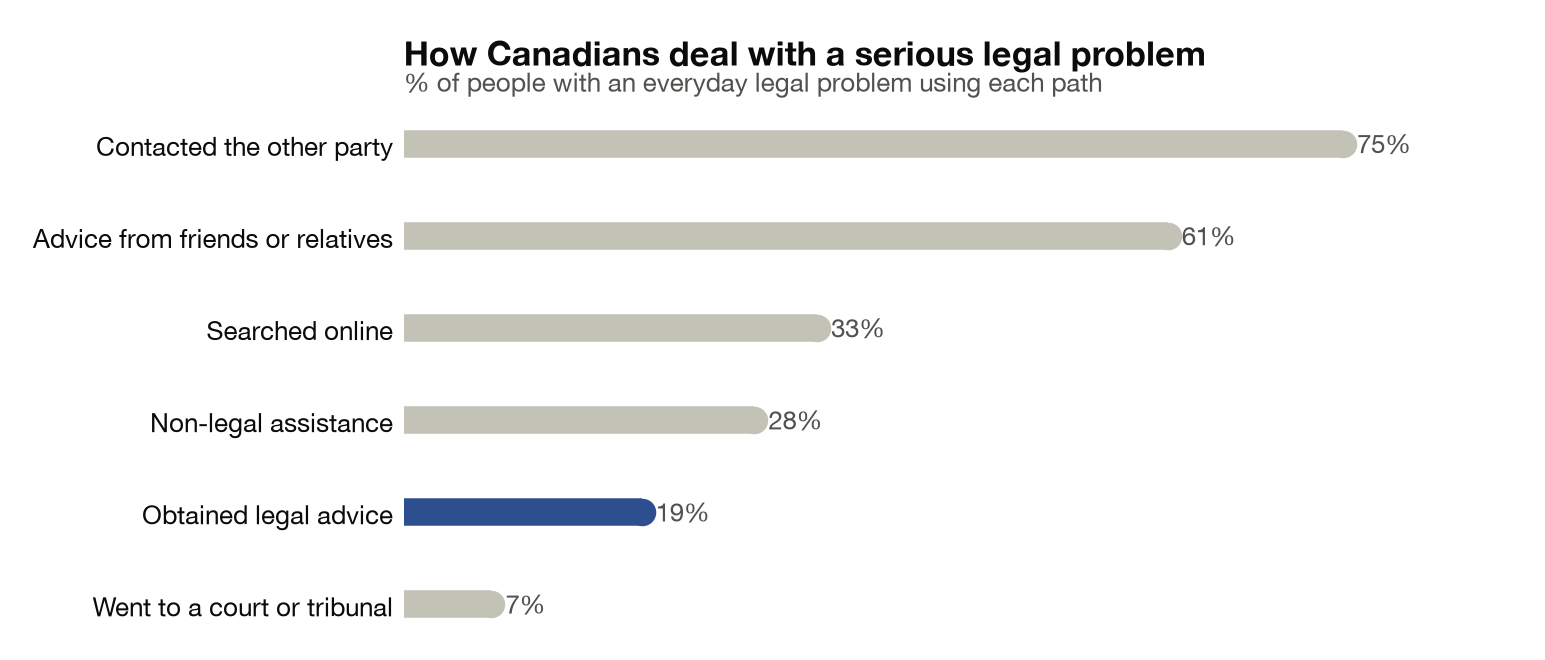
The legal market. Real output of legal services was C$18.1 billion in 2025, flat since 202116; 74.4% of employer establishments have fewer than five employees17; 72% of Ontario’s law firms are sole practitioners18. Only 19% of Canadians with a serious legal problem obtain legal advice19.
-
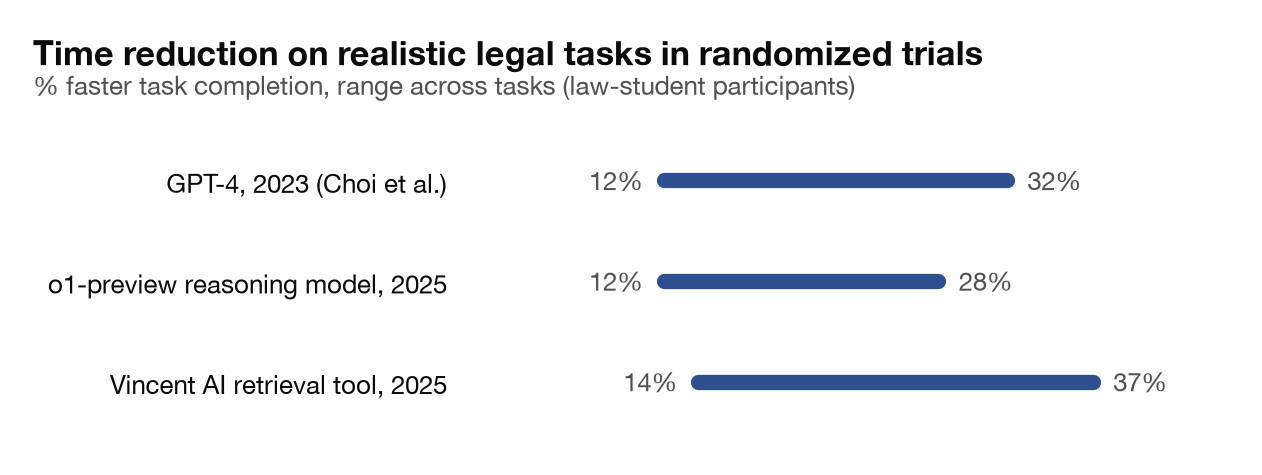
Evidence on legal AI. Randomized trials show 12–32% faster completion of realistic legal tasks with GPT-4 and 14–37% with a retrieval-based legal tool, the latter with higher quality20,21 — and commercial legal research tools still hallucinate in one of six to one of three answers22.
-
The model. Applying that evidence to 100,000 private-practice lawyers frees 10.1 to 52.6 million hours a year; the base case of 21.1 million hours is worth about C$8.4 billion at national billing rates and equals 11,000 full-time lawyers. Four fully automatable practice areas alone have a ceiling of 5.14 million professional hours a year.
2. The productivity problem Canada cannot ignore
In March 2024, Carolyn Rogers, Senior Deputy Governor of the Bank of Canada, told an audience in Halifax that Canadian output per hour had fallen from 88% of the US level in 1984 to 71% in 2022, after six straight quarters of decline, and that the business-sector productivity level was unchanged over seven years. She did not soften it: “I’m saying that it’s an emergency — it’s time to break the glass”3.
The most recent data do not contradict her. On the OECD’s measure, Canada produced US$75.3 per hour worked in 2024 against US$100.1 in the United States and US$84.5 for the OECD as a whole1. Statistics Canada’s own comparison puts the Canada-to-US labour-productivity ratio at 73.9 in the third quarter of 2025, indexed to 100 in 1997 — a 26% relative decline over a working lifetime2.
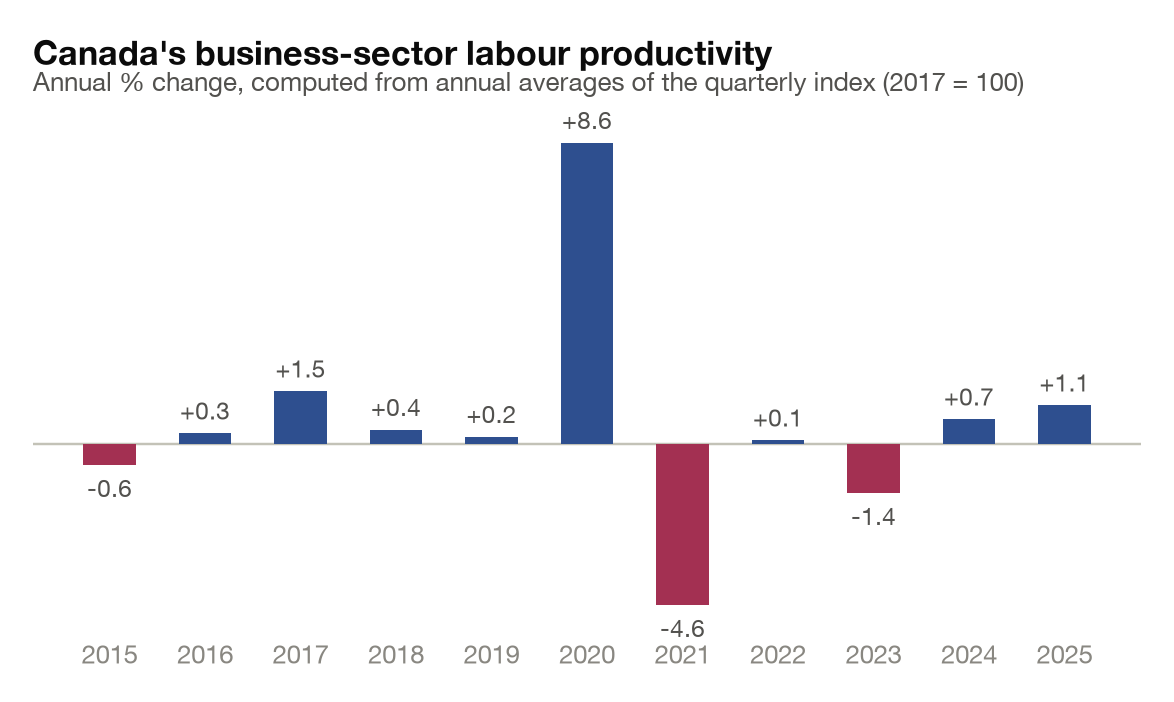
Growth has been close to zero for a decade. Statistics Canada’s business-sector labour productivity index averaged 98.3 in 2015 and 104.6 in 2025; strip out the pandemic composition spike of 2020 and its unwind, and the underlying rate is a fraction of a percent a year, with three consecutive annual declines from 2021 to 2023 before gains of 0.7% in 2024 and 1.1% in 202523,24.
Two features of the gap matter for this paper. First, it is concentrated in small firms. Statistics Canada finds that Canadian business-sector productivity was 73% of the US level in 2019 (down from 83% in 2002); small Canadian firms operate at 70% of their US counterparts while large firms operate at 87%, and small firms account for 58% of Canada’s business-sector GDP against 45% in the United States25. Whatever closes the gap has to work for firms with a handful of employees.
Second, it is an investment gap. The C.D. Howe Institute estimates that in 2025 Canadian workers will receive about 55 cents of new business capital for every dollar received by US workers, and 70 cents per OECD dollar; investment per available worker is almost a quarter below its 2014 peak4. Machinery-and-equipment investment per worker has fallen from 63 cents on the US dollar in 2008 to 32 cents in mid-2025: roughly US$12,800 per worker in the United States against $4,100 in Canada5.
Dynamism is fading too. The business entry rate roughly halved from 24.5% in 1983 to 13.1% in 201226; in 2023 it fell again, to 12.3%, while the exit rate rose to 11.9% and the stock of active businesses grew just 0.5%, the weakest non-pandemic growth since 200927. Since early 2024, more businesses have exited than entered each quarter, and 55% of small-business owners say they would not recommend starting a business now28. A country whose firms are not forming, not investing, and not growing more productive is a country whose professional-services layer has to do more with less.
3. A conservative economy of small firms
Canada’s private sector is structurally small. As of December 2024 there were 1.10 million employer businesses; 98.2% were small (1–99 employees), 1.5% medium, 0.3% large, and small firms employed 5.8 million people, 46.6% of the private labour force6. About 105,000 small businesses are created every year and 93,000 exit; 91% of new firms start with one to four employees6. Roughly two-thirds survive five years and fewer than half survive ten6.
These firms carry a compliance load that scales the wrong way. The Canadian Federation of Independent Business puts the cost of regulation at $51.5 billion in 2024, up 13.5% from 2020, of which $17.9 billion is red tape; businesses spent 768 million hours complying, the equivalent of nearly 394,000 full-time jobs7. The average small business owner spent 735 hours on compliance in 2024, 256 of them on avoidable red tape. Per employee, the smallest firms pay $10,208 and spend 198 hours; firms with 100 or more employees pay $1,374 and spend 88.
The relationship with the state that administers this is not a warm one: 66% of small-business owners report feeling intimidated by the Canada Revenue Agency, 48% say they were not given the tax guidance they needed, and only 23% are confident in call-centre answers29. For a federal corporation, the recurring obligations are concrete: an annual return within 60 days of the anniversary date, and since January 22, 2024 an annual filing of the register of individuals with significant control, plus a filing within 15 days of any change30. Miss the return for two years and the corporation is administratively dissolved after a 120-day notice; the law permits dissolution after one31. In 2019, administrative dissolutions of federal corporations (15,066) outnumbered voluntary ones (9,954)32 — the most common way a Canadian corporation dies is a missed $12 filing.
Technology adoption follows the same shape. BDC finds that 96% of SMEs invested in digital technologies in 2025, but only 23% reach high digital maturity and only 30% use generative AI; it estimates closing the maturity gap could lift SME productivity by up to 38% and GDP by about $350 billion33. Statistics Canada’s business survey puts the share of all businesses using AI to produce goods or deliver services at 19.2% in the second quarter of 2026 — triple the 6.1% of 2024, but still one firm in five13.
One finding from Statistics Canada should shape any product built for this economy. AI-adopting firms appear 16.8% more productive than non-adopters, but that premium shrinks to 10.2% once pre-existing productivity is controlled for and to a statistically insignificant 5.1% once complementary investments — R&D, cloud, data analytics, training — are accounted for34. Adoption alone does not raise productivity; capability does. For a firm of three people, the capability has to arrive inside the product, already integrated with the law it applies, not as a tool the firm is expected to configure.
4. The talent leak
Emigration of Canadian citizens and permanent residents reached a record 120,640 in 2025, with a record 41,203 leaving in the third quarter alone and a record first quarter of 30,092 in 2026; net emigration was 65,706 for the year, up from 35,791 in 20199. The people leaving are disproportionately young and educated: close to 70% hold a university degree, two-thirds are aged 20 to 44, nearly a quarter work in natural and applied sciences, and the United States hosts 61% of Canadian-born people living abroad10.
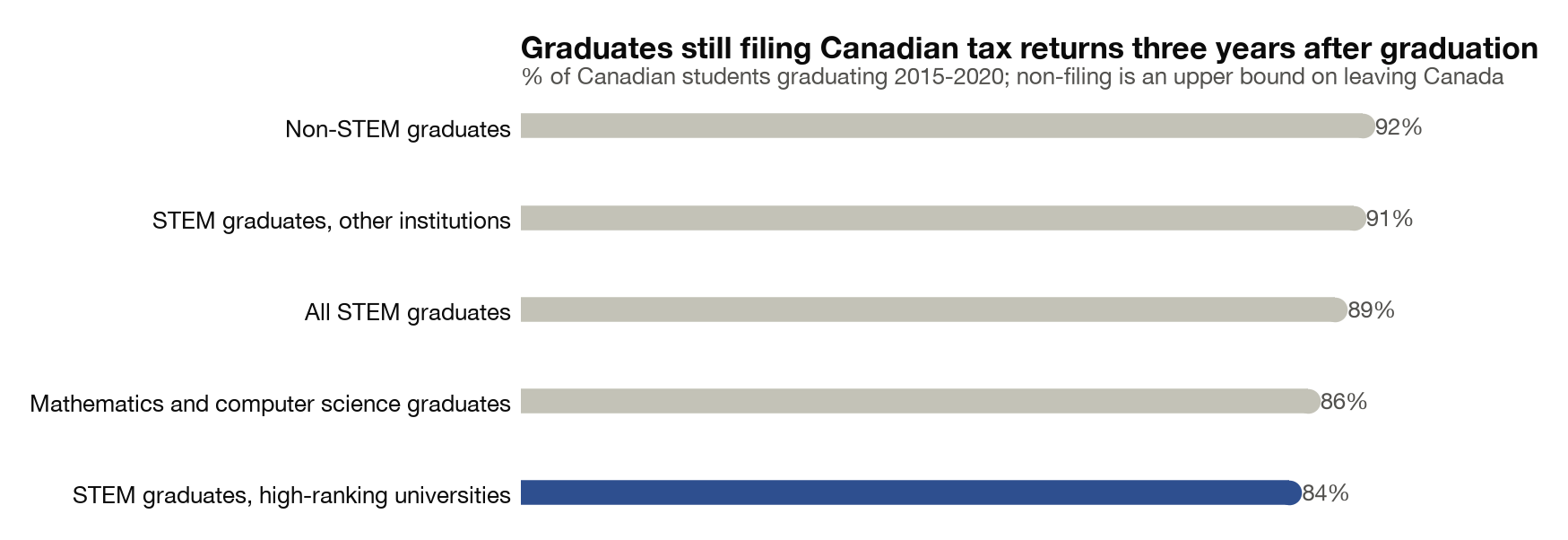
The best-known estimate of the technical leak is the 2018 Brock University study for Delvinia and Mitacs, which found one in four recent STEM graduates of Waterloo, UBC and the University of Toronto working in the United States, rising to two-thirds of software-engineering graduates35. Statistics Canada’s 2025 tax-filing study gives a lower national figure — about 11% of Canadian STEM graduates were no longer filing Canadian returns three years after graduation, 16% for graduates of high-ranking universities — but the direction is the same: the more selective the institution and the more computational the field, the higher the outflow36.
The economic weight of the leak is larger than its headcount. Bank of Canada researchers estimate that at least 40% of Canadians whose ability would place them in the top income percentile reside outside Canada, and that the top 10% of earners account for three-quarters of the Canada–US gap in GDP per adult and up to two-thirds of the labour-productivity gap11. TD Economics puts the median pre-tax wage premium for US tech workers at 46% over Canada before exchange rates or equity, and finds exit rates roughly double at the top of the skill distribution37. Founders follow the same gradient: nearly half of Canadian founders who raised $1 million or more in 2024 were based in the United States, and the US went from producing 11 times more high-potential startups than Canada in 2015 to 45 times more in 202438. Skilled immigrants leak too: one in five immigrants leaves within 25 years, high-skilled immigrants at twice the rate of low-skilled ones in the first five39.
The counter-evidence deserves equal weight. Formal channels for Canadians moving south have narrowed: Canadian applications for US labour certification fell 26% from 2015 to 2024, and Canadian-born admissions to US permanent residence run about 30% below late-2000s levels36. Canada added more tech jobs in 2024 (66,600, +5.9%) than the entire United States (64,140, +1.1%)40; in the year to March 2023 it gained 32,115 tech workers from abroad against a net loss of 1,672 to the United States41; Canadian students who study in the US now return at a 65% rate, up from 50% in 201142; and 91% of graduates of Vector Institute-recognized AI programs remain in Ontario43. The honest reading is that Canada is not being emptied — it is being skimmed. It keeps volume and loses the top of the distribution, which is exactly where productivity is made.
5. AI in Canada: research power, deployment lag
Canada’s standing in AI research is not in question. It ranks second in the world in AI research papers per capita, third in the share of AI researchers in the top 0.5% by citations, fifth in the number of AI startups, and hosts more than 130 Canada CIFAR AI Chairs12. The 2024 Global AI Index places it in the top ten overall, with the third most comprehensive government strategy and the top ranking for public investment in high-end compute44. Budget 2024 committed $2.4 billion, of which $2 billion funds the AI Compute Access Fund and a sovereign compute strategy45.
Deployment is another matter. Beyond the 19.2% headline, the Bank of Canada’s Business Leaders’ Pulse finds that 70% of business leaders use AI personally in a typical week but only 8% of firms report significant operational use, 21% moderate and 29% infrequent14. Across the OECD, 40% of large firms use AI against 11.9% of small ones, and half of Canadian SMEs cite lack of knowledge as the barrier46. Public optimism is among the lowest measured: 40% of Canadians see AI as more beneficial than harmful, and Canada does not appear in the 2025 AI Index’s league table of private AI investment led by the US at US$109.1 billion47. There is still no federal AI statute: Bill C-27 and its Artificial Intelligence and Data Act died in committee when Parliament was prorogued in January 202548.
The legal profession’s rules of engagement
The Canadian legal profession has answered AI with rules rather than bans, and the rules point in one direction: verification. The Federation of Law Societies’ Model Code treats technological competence as part of the duty of competence49. The Law Society of British Columbia’s October 2023 guidance maps generative AI onto existing duties of competence, confidentiality, fees and supervision50; the Law Society of Ontario’s April 2024 white paper encourages experimentation while making clear that “it remains the responsibility of the licensee to ensure that it is their product and reflects their expert legal opinion,” naming hallucination, confidentiality leakage and bias as the risks51.
The courts went further. The Federal Court requires a first-paragraph declaration whenever filed material contains AI-generated content and adopts a “human in the loop” principle, naming CanLII among trusted sources52. Ontario’s Superior Court requires counsel to verify AI-derived citations against authoritative sources, to certify authenticity under Rule 4.06.1(2.1), to hyperlink to CanLII, and warns that “AI-generated references may include incorrect or fictitious legal authorities,” with sanctions up to contempt and Law Society referral53; dedicated AI practice directions followed — for civil and family proceedings in November 2025 and for criminal proceedings in February 202654. British Columbia produced the country’s first costs ruling over ChatGPT-fabricated cases, Zhang v. Chen, 2024 BCSC 285, which noted research showing hallucination rates of 69–88%55.
Against that backdrop, adoption inside firms is real but shallow. A 2024 Thomson Reuters Institute survey put generative-AI use at about 26% of Canadian lawyers with a further 24% planning to adopt56; by December 2025, a survey of 344 firms covering about 11% of the active bar found 46% exploring, 37% piloting and only 7% with AI fully implemented across practice areas, with US firms having automated 32% of administrative tasks against 21% in Canada15. A 2026 Thomson Reuters Canadian survey found 89% of firms piloting or integrating AI — and only 18% of small firms obtaining client consent for its use57. The data commons underneath all of this, CanLII, holds more than 3.5 million works, bars bulk and programmatic downloading, sued Caseway AI in November 2024 over alleged scraping of the collection58, and announced a settlement on confidential terms in March 202659; its official API is read-only and metadata-oriented58. Any Canadian legal AI that treats case law as something to crawl rather than to license and verify will not survive contact with either the courts or the commons.
6. The Canadian legal market
Legal services are a C$18.1 billion industry in real terms — 12% above 2019 but flat since 202116 — delivered by 52,204 establishments, 30,009 of them with no payroll employees; 74.4% of employer establishments have fewer than five employees, and only eight in the country have 500 or more17. The typical firm is small and profitable: among 31,808 businesses with revenue between $30,000 and $5 million, average revenue was $409,200 in 2024 and 86.2% were profitable60. Canada had 117,467 active law-society members in 2025, 46,654 of them in Ontario18; 9,148 of Ontario’s 12,651 registered firms (72%) are sole practitioners and 97% have ten or fewer lawyers; in British Columbia the sole-practitioner share is 73%18.
This is the same small-firm structure that drives the national productivity gap, and it produces the same result. Clio’s Legal Trends data show the average lawyer bills about a third of an eight-hour day — 37% utilization, 2.9 billable hours — and collects $910 of every $1,000 billed61. National average hourly rates run from C$278 for a 2023 call to C$507 at twenty years62; median flat fees are C$1,297 for a residential purchase, C$1,000 for a sale and C$750 for a basic employment-contract review, against C$70,000 for a seven-day civil trial62.
Demand is not the constraint. The Canadian Forum on Civil Justice’s national survey found that 48.4% of adult Canadians — about 11.4 million people — experience at least one serious, hard-to-resolve civil or family legal problem in any three-year period, spend just over C$7.7 billion a year dealing with them, and that only about 19% obtain legal advice and about 7% reach a court or tribunal19. In 2024/2025, at least one respondent was self-represented in 65% of the roughly 278,500 active family-law cases63; at least one defendant was self-represented in 56% of general civil cases64.
Adoption sentiment is ahead of adoption. Clio reports AI use among North American legal professionals jumping from 19% in 2023 to 79% in 2024, with solo practitioners’ software spending growing 56% a year65, and that two-thirds of Canadian legal professionals say AI has already improved their firm’s revenue66. Thomson Reuters measured organizational generative-AI use in legal nearly doubling from 14% to 26% between 2024 and 2025 in a sample that was 15% Canadian67. Canadian respondents to a six-country LEAP survey reported the largest time savings from AI of any country, yet 42% still spend more than two hours a day on administration68. The market is telling vendors what it wants: not another assistant, but work taken off the desk.
7. What Misolla targets
Misolla’s pivot narrows its operating scope to Canadian law — federal and provincial — and rebuilds the product as a set of practice-area workflows, each of which can be run end to end with a lawyer’s approval as the only human step69. The practice areas were chosen by three tests: the volume of matters, the share of the work that is rule-bound enough to automate fully, and the existence of a public data or filing interface. The table gives the addressable base for each.
| Practice area | Annual base | Anchor | Source |
|---|---|---|---|
| Corporate maintenance | ≈640,000 active federal corporations (458,780 published at end-2020) | Annual return + ISC filing every year; 15,066 administrative dissolutions in 2019 | 70, 32 |
| Residential real estate | 470,314 resale transactions (2025), two files each | Median fees C$1,297 purchase / C$1,000 sale | 71, 62 |
| Small claims (Ontario) | >62,000 new proceedings a year; 45% of all civil actions | Limit raised to $50,000 on Oct. 1, 2025 | 72 |
| Criminal | 228,425 adult cases completed (2023/24) | Legal Aid tariff: 15–17 hours per Indictable-I file | 73, 74 |
| Founders | ≈105,000 new small businesses a year; 68,277 federal incorporations in 2020 | 735 compliance hours a year per small business; 68% five-year survival | 6, 32, 8 |
Table. Addressable bases for Misolla’s first practice areas. Figures are the latest published; the federal-corporation count is computed from Corporations Canada open data because no statistical report has been published since 2020.
Ontario is the first province because it is the largest market and because its courts have already written the verification rules a product must satisfy: its Superior Court alone intakes more than 200,000 criminal, 110,000 civil and 46,000 family matters a year, plus about 30,000 probate applications75. Corporate maintenance comes first because it is the most rule-bound, has the largest base and the clearest public interface, and because the ISC regime that took effect in January 2024 made every federal corporation a recurring compliance client whether it knows it or not30.
Founders are a distinct product for the same economy. Online, lawyer-free incorporation is now mainstream — RBC’s Ownr alone has registered or incorporated more than 239,000 businesses since 201776 — but the year after incorporation is where firms die: entry rates have fallen to the level of exit rates77, net formation has stalled at roughly zero monthly growth78, and venture capital has been flat at C$7–8 billion a year with deal counts falling and no IPOs in 202579. The Canadian programs that could help are large but underused by the smallest firms: SR&ED processes about 23,000 claims and allows C$4.5–4.6 billion a year, yet businesses under $4 million in revenue file 64% of claims and receive a third of the credits80; NRC IRAP funded 3,136 firms with $393 million in 2024–2581. A founder product that keeps the corporation compliant, maintains it, and routes it to the programs it qualifies for is aimed at the one gap every other statistic in this paper points to.
8. Evidence that legal AI moves the needle — and its limits
The randomized evidence is recent, small, and consistent. The first controlled trial of generative AI on realistic lawyering tasks (Choi, Monahan and Schwarcz) found GPT-4 cut law students’ completion time by 12–32% with only slight, inconsistent effects on quality20. A 2025 trial with 127 students found that a retrieval-augmented legal tool and a reasoning model raised productivity by 50–130% on five of six tasks and, unlike GPT-4 two years earlier, improved quality as well — time savings of 14–37% and 12–28%, quality gains of 8–15% and 10–28%, and far fewer hallucinations from the retrieval tool82,21.
Practitioner expectations line up with the trials. Thomson Reuters’ 2025 Future of Professionals survey projects five hours a week saved within a year, up from four in 2024; legal professionals expect to free nearly 240 hours a year, worth about $19,000 each83,84; the 2024 survey projected 4, 8 and 12 hours a week at one, three and five years against a 46-hour work week85. The Canadian figure is the same: five hours a week, about C$26,200 a year per Canadian legal professional57. Task-exposure studies bracket the ceiling: Goldman Sachs puts 44% of legal work tasks within reach of automation86; Clio puts 74% of hourly-billed work in that category, and 57% of lawyers’ tasks specifically87.
The limit is equally well measured. Stanford’s pre-registered benchmark of more than 200 legal queries found the leading commercial research tools answering incorrectly more than 17% of the time, and one more than 34% — against 58–82% for general-purpose chatbots22. That is the number the Ontario practice direction is written against. It is also why the productivity gains in the 2025 trial came with retrieval, not without it: the tool that grounded its answers in a legal corpus produced three hallucinations where the reasoning model produced eleven21. The design conclusion is not subtle. Speed comes from automation; trust comes from verification; a Canadian product needs both, against Canadian sources, or it produces the case the courts have already sanctioned.
Editor's note — Model figures are estimates under stated assumptions. Every input in section 9 is either a cited figure or a labelled assumption; the hours per file scale linearly, and section 9.4 lists the limitations.
9. What full automation could return: a model
The model below is deliberately simple and every input is either a cited figure or a labelled assumption. It answers two questions: how many professional hours could Canada-specific legal automation free across the private bar, and how many within the practice areas Misolla is building first.
9.1 National lawyer-time model
Base. 100,000 lawyers in private practice — a rounded assumption below the 117,467 active law-society members, to exclude in-house and government counsel and Quebec notaries18 — each working 240 days of eight hours (1,920 hours) and billing 2.9 of them, per Clio’s utilization data61. Exposure. The share of work that automation can touch is 44% (Goldman Sachs, task exposure86) in the conservative and base cases and 74% (Clio, hourly-billed work87) in the ambitious case. Realized saving on exposed work. 12% (the low end of the GPT-4 trial20), 25% (the midpoint of the two trials), and 37% (the high end of the retrieval-tool trial21). Value. A blended C$400 an hour, between the national five-year and ten-year call averages62.
| Scenario | Exposed × realized | Hours per lawyer-year | National hours | Lawyer-FTE equivalent | Value at C$400/h |
|---|---|---|---|---|---|
| Conservative | 44% × 12% = 5.3% | 101 | 10.1 M | 5,280 | C$4.1 B |
| Base | 44% × 25% = 11.0% | 211 | 21.1 M | 11,000 | C$8.4 B |
| Ambitious | 74% × 37% = 27.4% | 526 | 52.6 M | 27,380 | C$21.0 B |
Table. National lawyer-time scenarios. 100,000 private-practice lawyers × 1,920 worked hours × exposure × realized saving.
Two checks. The base case frees 211 hours per lawyer-year; Canadian lawyers surveyed by Thomson Reuters expect about 24057 — the model built from trial data and task-exposure studies lands within 12% of what the profession itself expects, from an independent route. And the base-case value of C$8.4 billion is about 46% of the industry’s real output of C$18.1 billion16: large for the sector, invisible in national GDP. The economic case for legal automation is not the legal industry’s own output. It is what the hours do next.
9.2 Practice-area ceilings
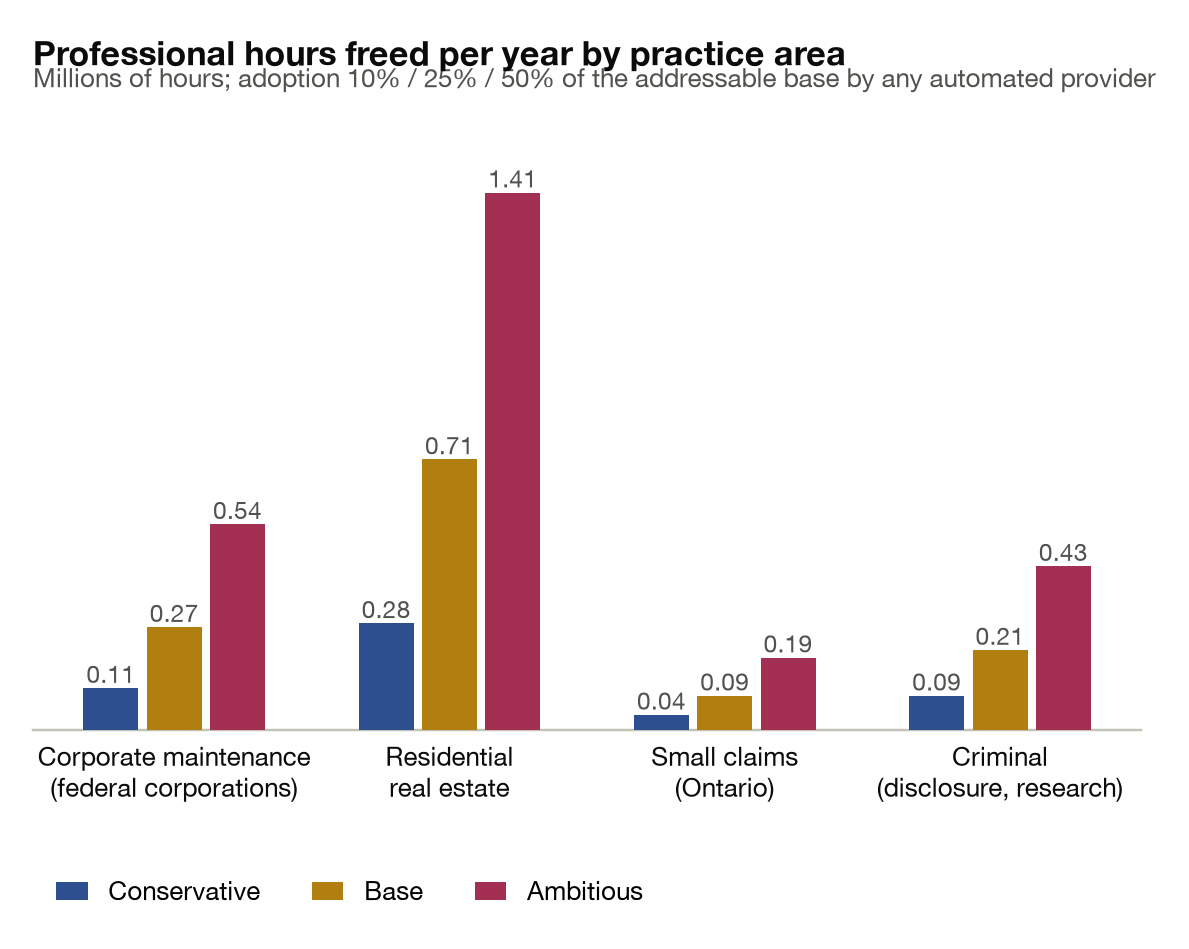
For the four practice areas Misolla builds first, the model multiplies the addressable base by professional hours per file and by the share of those hours that is fully automatable. Hours per file are assumptions where no published figure exists and are stated as such: 2.0 professional hours a year per federal corporation for the annual return, ISC filing, annual resolutions and minute book, 85% automatable; 6.0 hours per residential real-estate file (the median C$1,297 fee at an effective rate of about C$215 an hour), 50% automatable because search, registration, trust and undertakings remain licensed human work; 10 hours per represented small-claims file, 60% automatable; and for criminal files the Legal Aid Ontario tariff of 15 hours74, of which 25% — disclosure indexing and research — is automatable.
| Practice area | Base | Hours per file × automatable | Ceiling (100% adoption) |
|---|---|---|---|
| Corporate maintenance (federal) | 640,000 corporations | 2.0 h × 85% | 1.09 M h |
| Residential real estate | 940,628 files (470,314 × 2) | 6.0 h × 50% | 2.82 M h |
| Small claims (Ontario) | 62,000 proceedings | 10 h × 60% | 0.37 M h |
| Criminal (disclosure, research) | 228,425 cases | 15 h × 25% | 0.86 M h |
| Total | 5.14 M h ≈ 2,676 lawyer-FTE |
Table. Practice-area automation ceilings at 100% adoption. Provincial corporations, and every province but Ontario for small claims, are excluded, so the ceiling is a floor.
Founders are counted in owner-hours rather than lawyer-hours. If the corporate and legal slice of a small business’s 735 annual compliance hours8 is 5% and 60% of it can be automated, each corporation recovers about 22.1 owner-hours a year; across 640,000 federal corporations that is a ceiling of 14.1 million hours, or 3.5 million at 25% adoption — time returned to people whose firms have a 68% chance of surviving five years6.
9.3 What it means for the economy
Three channels carry the hours out of the legal sector and into the rest of the economy. The first is access: four in five Canadians with a serious legal problem never obtain legal advice19; when a small-claims file or a residential closing costs a fraction of today’s hours, the price of advice falls toward what those people will pay, and self-representation rates of 56% to 65%63,64 start to move. The second is compliance: the $51.5 billion that regulation costs Canadian businesses7 is paid mostly in hours, mostly by the smallest firms, and corporate maintenance is the part of it that is entirely rule-bound. The third is capital: the investment gap is a small-firm gap25,4, and a firm that is not spending its founder’s week on filings is a firm that can spend it on customers, hiring and the machinery Canada is not buying.
None of this closes the productivity gap by itself. It does something more specific: it takes one of the few professional-services functions that touches every one of Canada’s 1.1 million small firms and every one of its 640,000 federal corporations, and makes it exact, automatic, and cheap. That is what a small-firm economy needs, and it is what a product built to be adequate in 26 jurisdictions could never be.
9.4 Limitations
-
The randomized evidence is from US law students on discrete tasks, not from practising Canadian lawyers on whole matters20; matter-level savings may be smaller, because unautomated steps then bind.
-
Thomson Reuters’ hours-saved figures are respondent expectations, not measurements84; the model uses them only as a cross-check.
-
Hours per file for corporate maintenance, real estate and small claims are stated assumptions; the sensitivity is linear, so halving them halves the ceiling.
-
Statistics Canada no longer publishes a legal-services revenue survey; real GDP for NAICS 5411 is used as the size proxy and understates nominal revenue16. Corporations Canada has published no statistical report since 2020; the 640,000 figure is a record count from its open-data file70.
-
Adoption shares (10%, 25%, 50%) are scenario parameters for the market as a whole, not a forecast of any single provider’s share.
10. Why Canada-only, and why now
A product that serves 26 jurisdictions has to hedge. It cannot know a statute cold, it cannot promise a filing is exact, and it cannot verify a citation against the one commons a Canadian court will accept. The evidence in this paper says the market that needs the opposite — exact, automatic, verified — is the one at home: an economy of very small firms, a bar of sole practitioners, courts that have already written the verification rule into their practice directions, and a compliance regime that dissolves corporations for a missed $12 form.
It also says the timing is not optional. Business AI adoption has tripled in two years13; 89% of Canadian firms are piloting or integrating AI57; the ISC regime has turned every federal corporation into a recurring compliance obligation30; and the first productivity increases in four years have arrived with the first serious public investment in compute24,45. The window in which a Canadian product can define what verified, automated legal work looks like in Canada is open now and will not stay open.
Know about other jurisdictions; do not operate in them. Build the law of one country into the product so completely that a lawyer’s approval is the only human step — and verify every authority against the source before it reaches anyone.
That is the thesis of Misolla’s pivot69. The government horizon follows from it: a platform that keeps Canadian corporations compliant and files against Corporations Canada’s own interfaces is, by construction, the kind of infrastructure a public administration can work with. We are building outward from the relationships that exist rather than toward a procurement that does not.
11. Methodology and verification standard
This paper was assembled on August 24, 2026 by six research agents, each assigned one dimension — the Canadian legal market, Canada’s productivity and investment problem, emigration of technical talent, AI in Canada, the startup and small-business ecosystem, and the measured productivity effect of legal AI — under three rules: every finding must come from a page the agent fetched in the same session; the exact URL and a verbatim quote of no more than forty words containing the figure must be recorded; and figures may not be supplied from memory. Primary sources were required wherever they exist (Statistics Canada, the Bank of Canada, the OECD, ISED and Corporations Canada, the Federation of Law Societies, the courts, peer-reviewed trials); secondary sources appear only where a primary page could not be reached, and are labelled as such in the references.
A second set of agents then re-opened every cited URL and checked three things — that the page exists, that the figure appears on it, and that the quote is faithful — marking each finding verified, corrected, or unverifiable, with instructions to default to unverifiable when in doubt. Of the 107 findings gathered, 97 were verified exactly as fetched, 5 were corrected — a date, a currency marker, a paraphrased quote or a source that had moved — and 5 were not re-verified and do not appear in this paper; every figure cited here is in the first two groups. Where researchers computed a figure from a downloaded dataset rather than quoting a published number — the count of active federal corporations, and the annual productivity changes derived from Statistics Canada’s quarterly index — the computation is stated in the text and the dataset is cited.
The same standard is the product standard. Misolla’s Canadian research layer treats any legal string not mechanically tied to a source as a fabrication risk, whoever produced it, and refuses to present as a citation anything it cannot resolve against the source. This paper is written to the rule it argues for.
This paper is a research and strategy document. It is not legal advice, and none of the figures in it should be relied on for a legal decision without verification against the cited source.
References
OECD (SDMX API). OECD Productivity database (DSD_PDB@DF_PDB v2.0), GDP per hour worked, US dollars per hour PPP converted, current prices. 2026-08-24 (data vintage fetched; observations for 2022-2025). https://sdmx.oecd.org/public/rest/data/OECD.SDD.TPS,DSD_PDB@DF_PDB,2.0/CAN+USA+OECD........?startPeriod=2022&format=csvfilewithlabels
Statistics Canada. Measuring Canada's economic performance relative to the United States (Economic and Social Reports, Carter McCormack and Ryan Macdonald). 2026-03-25. https://www150.statcan.gc.ca/n1/pub/36-28-0001/2026003/article/00004-eng.htm
Bank of Canada. Time to break the glass: Fixing Canada's productivity problem. 2024-03-26. https://www.bankofcanada.ca/2024/03/time-to-break-the-glass-fixing-canadas-productivity-problem/
C.D. Howe Institute. Canada's Investment Crisis: Shrinking Capital Undermines Competitiveness and Wages (Commentary 699, William B.P. Robson and Mawakina Bafale). 2025-12-04. https://cdhowe.org/publication/canadas-investment-crisis-shrinking-capital-undermines-competitiveness-and-wages/
C.D. Howe Institute. Time to break the glass on Canada's investment emergency (William B.P. Robson and Mawakina Bafale). 2025-09-26. https://cdhowe.org/publication/time-to-break-the-glass-on-canadas-investment-emergency/
Innovation, Science and Economic Development Canada (ISED). Key Small Business Statistics 2025. 2025 (data as of December 2024). https://ised-isde.canada.ca/site/sme-research-statistics/en/key-small-business-statistics/key-small-business-statistics-2025
Canadian Federation of Independent Business (CFIB). Canada's Red Tape Report, 7th edition (Laure-Anna Bomal and Marvin Cruz). 2025-01 (7th edition, released January 27, 2025). https://www.cfib-fcei.ca/en/research-economic-analysis/canadas-red-tape-report
Canadian Federation of Independent Business (CFIB). Small businesses spend over 250 hours or 32 business days a year wrapped up in red tape (news release, Red Tape Awareness Week). 2025-01-27. https://www.cfib-fcei.ca/en/media/small-businesses-spend-over-250-hours-or-32-business-days-a-year-wrapped-up-in-red-tape
Statistics Canada. Table 17-10-0040-01 Estimates of the components of international migration, quarterly (full-table CSV download). 2026-06-17 (Q1 2026 vintage). https://www150.statcan.gc.ca/n1/tbl/csv/17100040-eng.zip
Statistics Canada. Portrait of Canadian emigration (infographic 11-627-M2026013). 2026 (2021 Census and 2020 data). https://www150.statcan.gc.ca/n1/pub/11-627-m/11-627-m2026013-eng.htm
Bank of Canada. The Distributional Origins of the Canada-US GDP and Labour Productivity Gaps (Staff Working Paper 2024-49, MacGee & Rodrigue). 2024-12. https://www.bankofcanada.ca/wp-content/uploads/2024/12/swp2024-49.pdf
CIFAR (Pan-Canadian AI Strategy lead). Looking ahead: the future of AI in Canada. 2025-03-05. https://cifar.ca/cifarnews/2025/03/05/looking-ahead-the-future-of-ai-in-canada/
Statistics Canada. Analysis on artificial intelligence use by businesses in Canada, second quarter of 2026 (Canadian Survey on Business Conditions). 2026-06-11. https://www150.statcan.gc.ca/n1/pub/11-621-m/11-621-m2026010-eng.htm
Bank of Canada. Survey Evidence on Firm AI Adoption and its Implications (Staff Analytical Paper 2026-22). 2026-06-02. https://www.bankofcanada.ca/wp-content/uploads/2026/05/sap2026-22.pdf
Best Lawyers. Canadian Firms Explore AI, But Few Fully Embrace the Shift. 2025-12-12. https://www.bestlawyers.com/article/canadian-firms-explore-ai-but-few-fully-embrace-the-shift/7185
Statistics Canada. Table 36-10-0434-01 Gross domestic product (GDP) at basic prices, by industry, monthly (x 1,000,000) – full-table CSV. 2026-07-31 (data through May 2026). https://www150.statcan.gc.ca/n1/tbl/csv/36100434-eng.zip
Innovation, Science and Economic Development Canada (Statistics Canada Business Register special tabulation). Legal services - 5411 - Businesses - Canadian Industry Statistics. 2025 (reference year). https://ised-isde.canada.ca/app/ixb/cis/businesses-entreprises/5411
Federation of Law Societies of Canada. Federation Statistics Report 2025 (Section Three: Law Firms). 2026-06-24 (last modified). https://flsc.ca/wp-content/uploads/2026/06/FederationStatisticsReport2025.pdf
Canadian Forum on Civil Justice. Everyday Legal Problems and the Cost of Justice in Canada: Overview Report. 2016. https://www.cfcj-fcjc.org/sites/default/files/Everyday%20Legal%20Problems%20and%20the%20Cost%20of%20Justice%20in%20Canada%20-%20Overview%20Report.pdf
SAGE Journals (peer-reviewed; Schwarcz, Manning, Prescott, Barry, Cleveland, Rich). AI-Powered Lawyering: AI Reasoning Models, Retrieval Augmented Generation, and the Future of Legal Practice (citing Choi et al. 2024). 2026 (journal version; SSRN preprint March 2025; cites Choi et al. 2024). https://journals.sagepub.com/doi/10.1177/2755323X261427048
LawSites (Bob Ambrogi) - secondary press summarizing the SSRN paper; used because SSRN blocked fetch. Another New Study of Legal AI Shows Some Models Can Significantly Improve Work Quality and Efficiency. March 2025. https://www.lawnext.com/2025/03/another-new-study-of-legal-ai-shows-some-models-can-significantly-improve-work-quality-and-efficiency.html Secondary source; primary page could not be fetched.
Stanford HAI / RegLab. AI on Trial: Legal Models Hallucinate in 1 out of 6 (or More) Benchmarking Queries. May 23, 2024 (updated May 30, 2024). https://hai.stanford.edu/news/ai-trial-legal-models-hallucinate-1-out-6-or-more-benchmarking-queries
Statistics Canada. Table 36-10-0206-01 Indexes of business sector labour productivity, unit labour cost and related measures, seasonally adjusted (vector v1409153), via StatCan Web Data Service. 2026-06-03 (table release time; data to Q1 2026). https://www150.statcan.gc.ca/t1/wds/rest/getDataFromCubePidCoordAndLatestNPeriods
Statistics Canada. The Daily — Labour productivity, hourly compensation and unit labour cost, fourth quarter 2025 (and fourth quarter 2024). 2026-03-04 (Q4 2025 release); 2024 figure from https://www150.statcan.gc.ca/n1/daily-quotidien/250305/dq250305b-eng.htm dated 2025-03-05. https://www150.statcan.gc.ca/n1/daily-quotidien/260304/dq260304a-eng.htm
Statistics Canada. The role of firm size in the Canada–U.S. labour productivity gap since 2000 (Wulong Gu and Josip Lesica). 2025-12-22. https://www150.statcan.gc.ca/n1/pub/36-28-0001/2025012/article/00002-eng.htm
Statistics Canada. The long-run evolution of business entry and exit rates in Canada (Li Li, Economic and Social Reports). 2025-09-24. https://www150.statcan.gc.ca/n1/pub/36-28-0001/2025009/article/00001-eng.htm
Statistics Canada. The Daily — Business and employment dynamics data, 2023. 2026-02-12. https://www150.statcan.gc.ca/n1/daily-quotidien/260212/dq260212a-eng.htm
Canadian Federation of Independent Business (CFIB). Canada's Entrepreneurial Drought – Part 1: The Shrinking Business Landscape. 2026-04-15. https://www.cfib-fcei.ca/en/research-economic-analysis/canada-entrepreneurial-drought-part1
CFIB. 2023 CRA Report Card. 2023-04. https://www.cfib-fcei.ca/hubfs/red_tape/pdfs/2023-Apr-CRA-Report-Card-EN.pdf
Corporations Canada / ISED. Individuals with significant control. page modified 2026-03-30. https://ised-isde.canada.ca/site/corporations-canada/en/individuals-significant-control
Corporations Canada / ISED. Policy on annual filings – Canada Business Corporations Act. page modified 2026-02-25. https://ised-isde.canada.ca/site/corporations-canada/en/business-corporations/policy-annual-filings-canada-business-corporations-act
Corporations Canada / ISED. 2020 Annual Statistical Report — Corporations Canada (Table 3, CBCA dissolutions and revivals, 2012 to 2020). 2021-10-20. https://ised-isde.canada.ca/site/corporations-canada/sites/default/files/attachments/2022/cs09267_en.pdf
BDC (Business Development Bank of Canada). A $350B opportunity: Canada's next phase of growth to be driven by AI and digital technologies (news release for 'The Digital Transformation of SMEs in the Age of Artificial Intelligence'). 2026-06-03. https://www.bdc.ca/en/about/mediaroom/news-releases/350b-opportunity-canadas-next-phase-of-growth-to-be-driven-by-ai-and-digital-technologies
Statistics Canada. Artificial intelligence adoption and productivity in Canadian firms (Jiang Li and Huju Liu, Economic and Social Reports). 2026-04-22. https://www150.statcan.gc.ca/n1/pub/36-28-0001/2026004/article/00002-eng.htm
Delvinia (study funder, with Mitacs; lead researcher Zachary Spicer, Brock University / Munk School). One in Four STEM Talent Choosing to Work in the U.S. Over Canada After Graduation: Study (Reversing the Brain Drain). 2018-05-03. https://www.delvinia.com/reversing-the-brain-drain/
Statistics Canada. The Daily — Economic and Social Reports, July 2025: Retention of science, technology, engineering, mathematics and computer science graduates in Canada. 2025-07-23. https://www150.statcan.gc.ca/n1/daily-quotidien/250723/dq250723b-eng.htm
TD Economics (Beata Caranci, Francis Fong). Canada's Silent Brain Drain. 2026-05-21. https://economics.td.com/ca-silent-brain-drain
Leaders Fund. Where have all the Canadian startups gone? (The Future at Risk: Canada's Shrinking Startup Pipeline). 2025-09-22. https://leaders.vc/research/canadianstartups
Institute for Canadian Citizenship with the Conference Board of Canada. Highly Skilled Immigrants Twice as Likely to Leave Canada (The Leaky Bucket 2025). 2025-11-18. https://forcitizenship.ca/article/highly-skilled-immigrants-twice-as-likely-to-leave-canada/
CBRE. Scoring Tech Talent 2025. 2025. https://www.cbre.com/insights/books/scoring-tech-talent-2025
Technology Councils of North America (TECNA) / Canada's Tech Network. Canada Welcomed More Than 32,000 Tech Workers Over the Past 12 Months, Report Finds (Tech Workforce Trends). 2023-07-11. https://members.tecna.org/news/Details/canada-welcomed-more-than-32-000-tech-workers-over-the-past-12-months-report-finds-175229
Statistics Canada (Economic and Social Reports). Global classrooms: Changing patterns in postsecondary student flows between Canada and the United States. 2025-10-22. https://www150.statcan.gc.ca/n1/pub/36-28-0001/2025010/article/00002-eng.htm Secondary source; primary page could not be fetched.
Vector Institute. Vector Institute 2024-25 annual report: Where AI research meets real-world impact. 2025-07-22. https://vectorinstitute.ai/annualreport202425-summary/
Tortoise Media. The Global Artificial Intelligence Index 2024. 2024-09-19. https://www.tortoisemedia.com/2024/09/19/the-global-artificial-intelligence-index-2024
Government of Canada (Department of Finance). Budget 2024, Chapter 4: Economic Growth for Every Generation. 2024-04-16. https://budget.canada.ca/2024/report-rapport/chap4-en.html
OECD. AI adoption by small and medium-sized enterprises (OECD discussion paper for Canada's 2025 G7 Presidency). 2025-12. https://www.oecd.org/content/dam/oecd/en/publications/reports/2025/12/ai-adoption-by-small-and-medium-sized-enterprises_9c48eae6/426399c1-en.pdf
Stanford Institute for Human-Centered AI (HAI). The 2025 AI Index Report. 2025-04-07. https://hai.stanford.edu/ai-index/2025-ai-index-report
Parliament of Canada (LEGISinfo). C-27: An Act to enact the Consumer Privacy Protection Act, the Personal Information and Data Protection Tribunal Act and the Artificial Intelligence and Data Act (LEGISinfo). 2025-01-06. https://www.parl.ca/legisinfo/en/bill/44-1/c-27
Federation of Law Societies of Canada. Model Code of Professional Conduct, as amended April 2024. 2024-04. https://flsc.ca/wp-content/uploads/2024/11/2024-Model-Code-of-Professional-Conduct.pdf
Law Society of British Columbia. Practice Resource: Guidance on Professional Responsibility and Generative AI. 2023-10. https://www.lawsociety.bc.ca/getContentAsset/91264ae3-9fa0-4063-88fb-69977a293f62/dfc3d011-8f63-43f6-9ed8-4b444333a1d0/Professional-responsibility-and-AI.pdf?language=en-CA
Law Society of Ontario. Licensee use of generative artificial intelligence (White Paper, Futures Committee). 2024-04. https://lawsocietyontario-dwd0dscmayfwh7bj.a01.azurefd.net/media/lso/media/lawyers/practice-supports-resources/white-paper-on-licensee-use-of-generative-artificial-intelligence-en.pdf
Federal Court of Canada. Notice to the Parties and the Profession: The Use of Artificial Intelligence in Court Proceedings. 2024-05-07. https://www.fct-cf.ca/Content/assets/pdf/base/FC-Updated-AI-Notice-EN.pdf
Ontario Superior Court of Justice. Consolidated Civil Provincial Practice Direction — The Use of Artificial Intelligence (AI) for Court Proceedings. 2026-03-17. https://www.ontariocourts.ca/scj/filing-procedures/provincial/consolidated-civil-provincial-practice-direction/
Ontario Superior Court of Justice. New Practice Directions on the Responsible Use of Artificial Intelligence in Court Proceedings (civil and family posted November 20, 2025; criminal posted February 12, 2026). 2026-02-12. https://www.ontariocourts.ca/scj/news/new-practice-directions-on-the-responsible-use-of-artificial-intelligence-in-court-proceedings/
McCarthy Tétrault (secondary; bccourts.ca primary pages returned a TLS certificate error). Landmark Decision about Hallucinated Legal Authorities in BC Signals Caution… But Leaves Questions About Requirement to Disclose Use of AI Tools. 2024-03-21. https://www.mccarthy.ca/en/insights/blogs/techlex/landmark-decision-about-hallucinated-legal-authorities-bc-signals-caution-leaves-questions-about-requirement-disclose-use-ai-tools Secondary source; primary page could not be fetched.
Thomson Reuters Institute. The latest Canadian legal market findings from Thomson Reuters Institute (2024 State of the Canadian Law Firm Market Report, with the Canadian Bar Association). 2024-05-22. https://www.thomsonreuters.ca/en/insights/articles/the-latest-canadian-legal-market-findings-from-thomson-reuters-institute.html
Thomson Reuters (Legal blog, citing TR Canadian Legal Market survey). Canada: Why 89% of legal professionals are racing toward technology they're still concerned about. 2026-03-20. https://legal.thomsonreuters.com/blog/canada-why-89-of-legal-professionals-are-racing-toward-technology-theyre-still-concerned-about/
Torkin Manes LLP (secondary; canlii.org terms/about pages returned HTTP 403 — terms language quoted as reproduced by counsel commentary). Legality of Data Scraping Using AI: Revisiting in Canada. 2024-12-13. https://www.torkin.com/insights/publication/legality-of-data-scraping-using-ai-revisiting-in-canada Secondary source; primary page could not be fetched.
CanLII. Announcement regarding settlement between CanLII and Caseway (CanLII Blog). 2026-03-20. https://blog.canlii.org/2026/03/20/announcement-regarding-settlement-between-canlii-and-caseway/
Innovation, Science and Economic Development Canada (Statistics Canada Financial Performance Data). Legal services - 5411 - Financial performance - Canadian Industry Statistics. 2024 (data year). https://ised-isde.canada.ca/app/ixb/cis/performance/rev/5411
Clio (citing Legal Trends Report). How to Calculate Utilization Rate and Why You Need to Track It. 2024 (citing Legal Trends Report 2024). https://www.clio.com/blog/how-to-calculate-utilization-rate/
Canadian Lawyer (Key Media). The state of the Canadian legal fee landscape: an in-depth report. October 22, 2024 (data collected April-May 2024; 347 firms). https://www.canadianlawyermag.com/cl-plus/data-reports/the-state-of-the-canadian-legal-fee-landscape-an-in-depth-report/389271
Statistics Canada. The Daily — Family law cases in civil courts, 2024/2025. 2026-03-26. https://www150.statcan.gc.ca/n1/daily-quotidien/260326/dq260326b-eng.htm
Statistics Canada. The Daily — Canadian general civil caseloads from 2019/2020 to 2023/2024. 2026-01-20. https://www150.statcan.gc.ca/n1/daily-quotidien/260120/dq260120a-eng.htm
Clio. AI-powered legal practices surge: Clio's latest Legal Trends Report reveals major shift (2024 Legal Trends Report press release). 2024-10-07. https://www.clio.com/about/press/clio-latest-legal-trends-report/
Clio. Canada's AI-Powered Law Firms Are Pulling Ahead (Legal Trends for Canadian Law Firms press release). 2026-03-16. https://www.clio.com/about/press/canadas-ai-powered-law-firms-are-pulling-ahead-12345/
Thomson Reuters Institute. Generative AI Adoption Nearly Doubles as Professional Services Reach Crossroads (2025 Generative AI in Professional Services Report). 2025-04-15. https://www.thomsonreuters.com/en/press-releases/2025/april/from-incubation-to-integration-generative-ai-adoption-nearly-doubles-as-professional-services-reach-crossroads
Canadian Lawyer (reporting LEAP vendor survey - secondary, vendor-sponsored). Canada's firms lead in adopting emerging technology such as legal-specific AI: LEAP research. March 24, 2026. https://www.canadianlawyermag.com/resources/legal-technology/canadas-firms-lead-in-adopting-emerging-technology-such-as-legal-specific-ai-leap-research/393885 Secondary source; primary page could not be fetched.
Misolla AI. Major Pivot to a Canada-Focused Model: Transitioning Away From the Original Global-General Structure to a Hyper-Specialization Solutions Structure Tailored Towards Canadian Law (announcement). 2026-08-24. https://misolla.ai
Corporations Canada (open data), count computed by the authors. Federal corporations dataset — active CBCA corporations file (corporations-active-cbca-en.csv), record count as of 2026-08-24. 2026-08-24. https://open.canada.ca/data/en/dataset/0032ce54-c5dd-4b66-99a0-320a7b5e99f2
Canadian Real Estate Association (CREA). Home Sales in Canada End 2025 Quietly. 2026-01-15. https://www.crea.ca/media-hub/news/home-sales-in-canada-end-2025-quietly/
Ontario Superior Court of Justice. Ontario Superior Court of Justice: Progressing in the Public Interest — 2024-2025 Report. 2025-2026 (covers 2024 and 2025). https://www.ontariocourts.ca/scj/wp-content/uploads/annualreport/2024-2025-EN.pdf
Statistics Canada. Table 35-10-0027-01 Adult criminal courts, number of cases and charges by type of decision – full-table CSV (Integrated Criminal Court Survey). 2025-10-07. https://www150.statcan.gc.ca/n1/tbl/csv/35100027-eng.zip
Legal Aid Ontario. Tariff and Billing Handbook. Updated July 27, 2026 (first published October 2007). https://www.legalaid.on.ca/wp-content/uploads/LAO-tariff-and-billing-handbook-EN.pdf
Government of Ontario, Ministry of the Attorney General. 2024–2025 Court Services Division Annual Report — Introduction (Court Services Division: by the numbers). 2025 (fiscal 2024–2025). https://www.ontario.ca/document/2024-2025-court-services-division-annual-report/introduction-court-services-division
Royal Bank of Canada. 2025 Public Accountability Statement. 2025. https://www.rbc.com/community-sustainability/_assets-custom/pdf/public-accountability-statement-2025.pdf
Statistics Canada. Business and employment dynamics data, 2023. 2026-02-12. https://www.statcan.gc.ca/o1/en/app/9043-business-and-employment-dynamics-data-2023
Statistics Canada. The Daily — Monthly estimates of business openings and closures, December 2025. 2026-03-23. https://www150.statcan.gc.ca/n1/daily-quotidien/260323/dq260323b-eng.htm
CVCA (Canadian Venture Capital & Private Equity Association). Year-End 2025 Canadian Venture Capital Market Overview. 2026-02. https://www.cvca.ca/insights/market-reports/year-end-2025/
Canada Revenue Agency. Annual program statistics — Scientific Research and Experimental Development (SR&ED) tax incentives (Wayback Machine capture; live canada.ca URL returned HTTP 403 to this run). 2026 (page covers April 1, 2025 to March 31, 2026). https://web.archive.org/web/2026/https://www.canada.ca/en/revenue-agency/services/scientific-research-experimental-development-tax-incentive-program/annual-program-statistics.html
National Research Council Canada. National Research Council Canada's 2024-25 Departmental Results Report. 2025. https://nrc.canada.ca/en/corporate/planning-reporting/national-research-council-canadas-2024-25-departmental-results-report
University of Minnesota Law School Scholarship Repository (Schwarcz et al.). AI-Powered Lawyering: AI Reasoning Models, Retrieval Augmented Generation, and the Future of Legal Practice. 2025 (SSRN March 2025; journal 2026). https://scholarship.law.umn.edu/faculty_articles/1207/
Thomson Reuters (press release). The AI Adoption Reality Check: Firms with AI Strategies are Twice as Likely to see AI-driven Revenue Growth. June 26, 2025. https://www.thomsonreuters.com/en/press-releases/2025/june/the-ai-adoption-reality-check-firms-with-ai-strategies-are-twice-as-likely-to-see-ai-driven-revenue-growth-those-without-risk-falling-behind
Thomson Reuters Institute (full report PDF). Future of Professionals Report 2025. June 2025 (data gathered February-March 2025). https://www.thomsonreuters.com/content/dam/ewp-m/documents/thomsonreuters/en/pdf/reports/future-of-professionals-report-2025.pdf
Thomson Reuters Institute (full report PDF). Future of Professionals Report 2024. July 2024. https://www.thomsonreuters.com/content/dam/ewp-m/documents/thomsonreuters/en/pdf/reports/future-of-professionals-report-2024.pdf
Goldman Sachs Global Investment Research. The Potentially Large Effects of Artificial Intelligence on Economic Growth (Briggs/Kodnani). March 26, 2023. https://www.gspublishing.com/content/research/en/reports/2023/03/27/d64e052b-0f6e-45d7-967b-d7be35fabd16.pdf
Clio. Highlights from the Legal Trends Report: the Legal Industry in 2024. October 2024. https://www.clio.com/blog/highlights-from-2024-legal-trends-report/